The Advanced LIGO Gravitational Wave (GW) detectors at Hanford and Livingston have made remarkable improvements in GW strain sensitivity since beginning operations in 2015. These advances are the result of sustained efforts to systematically identify noise sources and manually optimize control loops to reduce noise in these exceptionally sensitive instruments. This process, known as commissioning, is essential for achieving design sensitivity in GW detectors. It relies on two key components: first, well-motivated and validated mathematical models of the detector; and second, algorithms for tuning and debugging the control loops to minimize noise in the target frequency band.
About the workshop
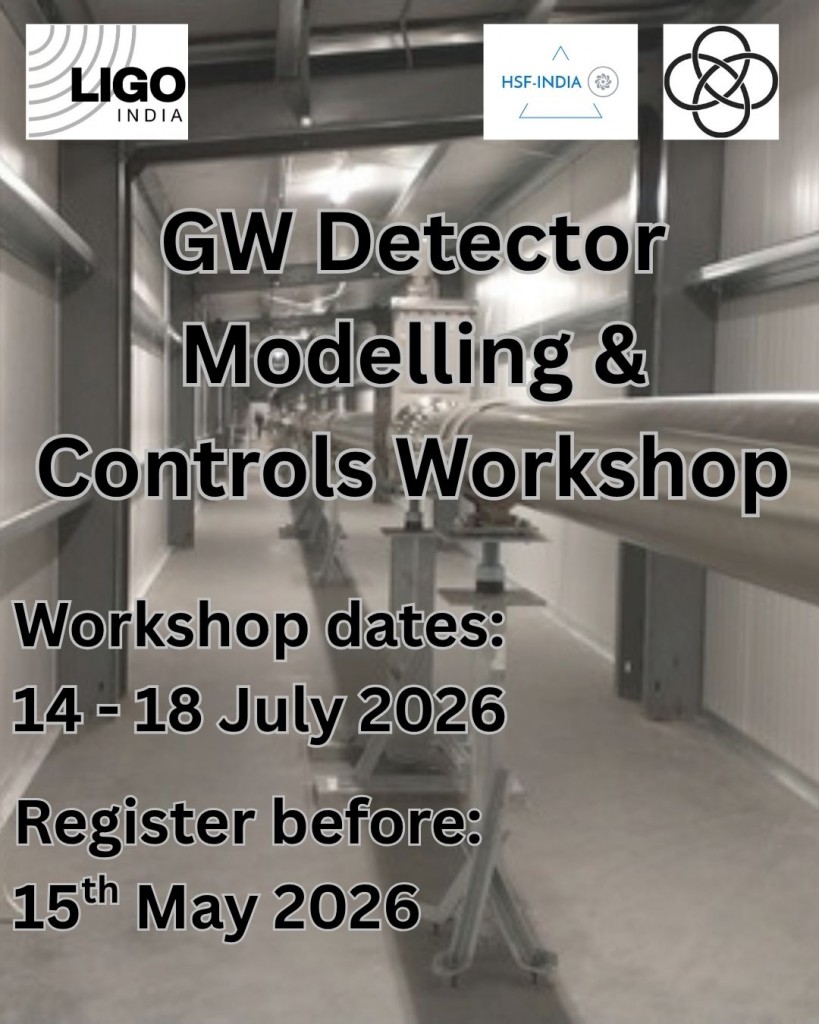
The LIGO-India megascience project, in collaboration with the LIGO-US project, aims to build and operate a working advanced LIGO detector in India by 2030. In addition to the facility infrastructure, this aggressive timeline requires a rapid buildup of trained manpower. Among the most critical skills are building accurate detector models and designing better feedback servo control systems. Building a strong research community in these areas is therefore essential for the successful construction and operation of LIGO-India. This workshop aims to introduce participants to the mathematical modeling of the GW detector and tools for developing complex multi-input, multi-output control loops. It is intended as a practical entry point into the field and to encourage more researchers to contribute to this effort.
This event is supported by IUCAA and HSF-India via the U.S. National Science Foundation grant OISE-2201990.
There will be no registration fee for the workshop. Local hospitality, including lodging and meals, will be provided for all selected participants, and travel support, in accordance with IUCAA norms, will also be available for participants who need it.
Interested students and researchers can apply via the registration form on the right. Applicants should have completed at least three years of undergraduate study after higher secondary school in physics, applied mathematics, or related science and engineering fields (such as electronics, optics, mechanics, or control systems).
What will you learn ?
GW interferometer simulations
Frequency domain modeling
Time domain modeling
Feedback control system
System identification
Transfer function or response function measurements
Servo filter design
Single-stage and multi-stage suspensions
Dual recycling Interferometers with minimal degrees of freedom
AI / ML in control system design
When and Where
Venue: IUCAA, Pune
Date:
Important dates:
Registration deadline: May 15, 2026
Organising Committee:
- Dr. Suresh Doravari
- Dr. Manasa P. T.
- Prof. Sanjit Mitra
- Prof. Nikhil Mukund
- Prof. Rana Adhikari
- Dr. Shivaraj Kandhasamy
Please visit the Indico website for more information: GW Detector Modelling and Controls Workshop.
Contact: li_events@iucaa.in, tel:+91-20-25604311